Tax Planning for Rental Property Construction: What to Structure Before You Break Ground
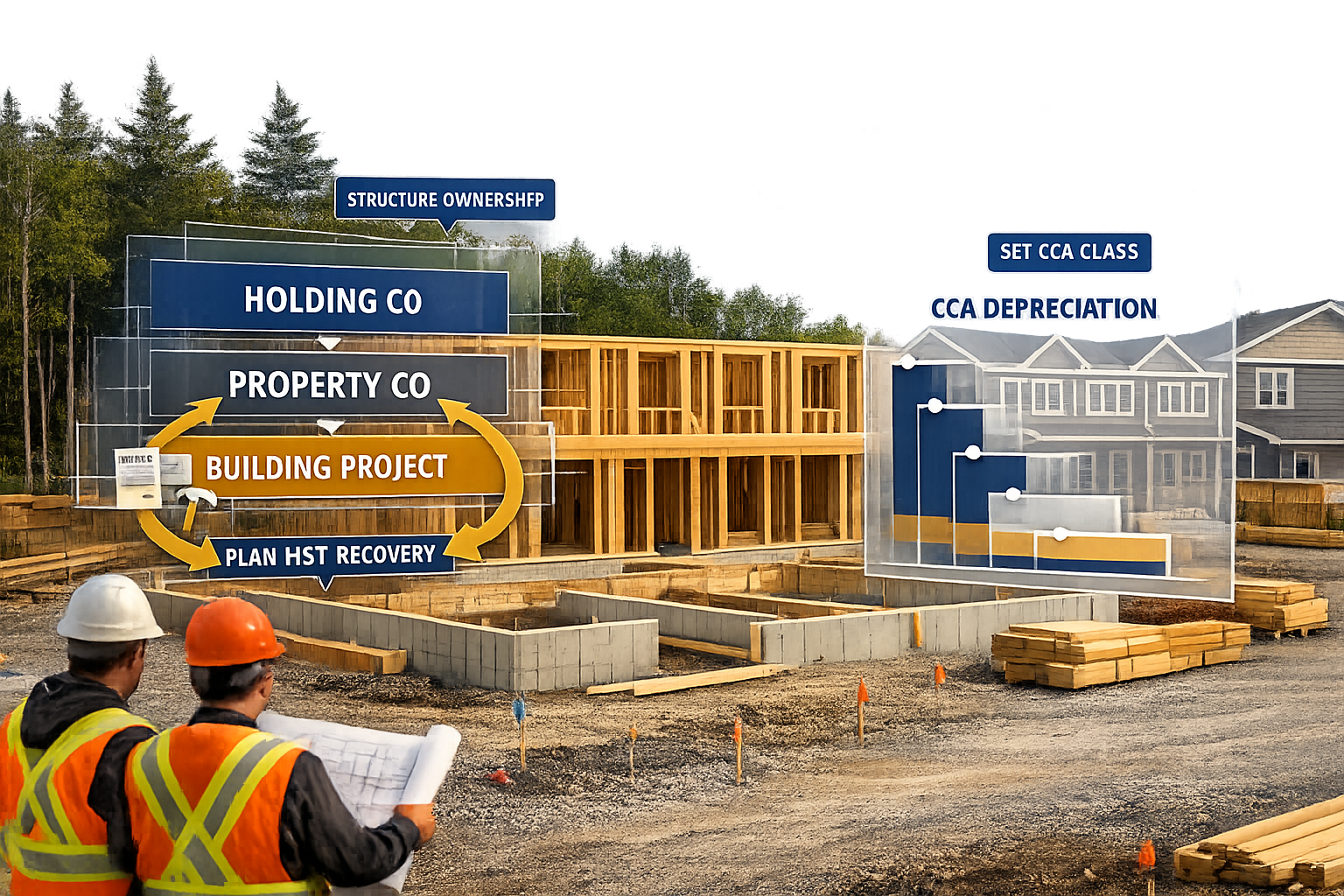
If you're about to start building a multi-unit rental property in Nova Scotia, you're likely wondering how to set up your project to avoid losing thousands in taxes. Here's a quick example: a Halifax developer saved $90,000 in taxes in the first year on a $1.8 million 12-unit build just by choosing corporate ownership, registering for HST early, and planning their capital cost allowance (CCA) properly. Over ten years, that decision increased their internal rate of return (IRR) from 9% to 12.5%.
The stakes are high - tax planning errors can eat up 5–10% of your project value. On a $2 million build, that’s $100,000 to $200,000 gone. This guide will help you figure out how to structure your ownership, handle HST recovery, and plan CCA before breaking ground, so you can keep more of your hard-earned returns.
How Rental Real Estate Actually Saves You Taxes (Step-by-Step Example)
sbb-itb-16b8a48
Personal vs Corporate Ownership: Which Structure Works Best
Personal vs Corporate Ownership for Rental Properties: Tax Comparison
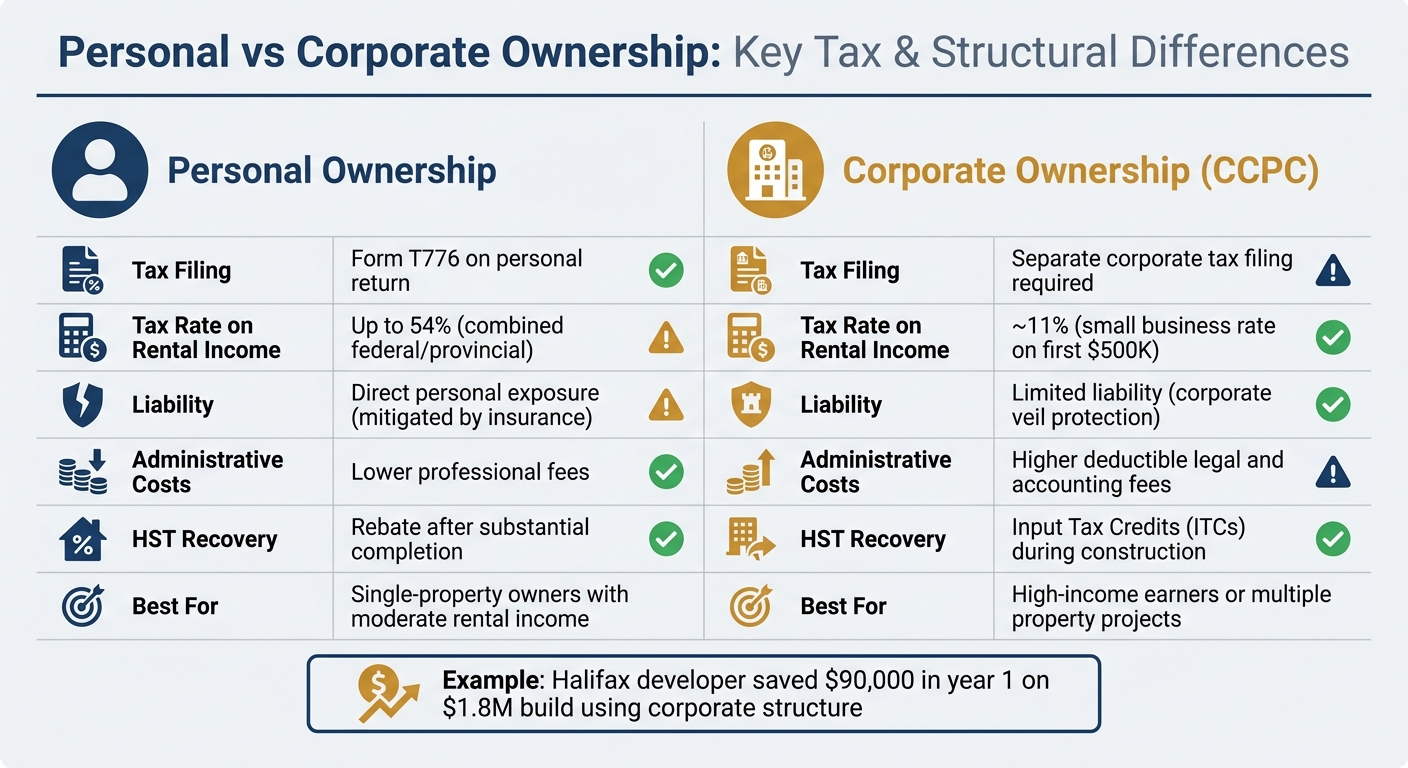
The ownership structure you select before starting construction has a direct impact on how your rental income is taxed, the financing options available to you, and the liability protection you receive. In Nova Scotia, property owners building multi-unit rentals (4+ units) often choose between holding the property personally or through a Canadian-controlled private corporation (CCPC).
Personal Ownership: Benefits and Drawbacks
When you hold a property personally, rental income and expenses are reported on your personal tax return. This approach is straightforward and comes with fewer administrative tasks - there’s no need for separate corporate tax filings or paying annual corporate fees.
The downside? Higher tax exposure. Rental income is added to your personal income, which, in Nova Scotia, can push your combined federal and provincial tax rates to as high as 54% if you fall into the top tax bracket. Additionally, personal ownership exposes you to direct liability. While insurance (which is fully deductible and HST-exempt) can reduce this risk, it doesn’t eliminate it entirely.
Corporate Ownership: Benefits and Drawbacks
Owning property through a CCPC offers limited liability protection, shielding your personal assets. CCPCs also benefit from a lower tax rate - around 11% on the first $500,000 of active business income - allowing you to defer personal taxes until you take money out as a salary or dividends. This can be particularly beneficial if your rental income is substantial.
Another advantage is that CCPCs may qualify as "Eligible Persons or Partnerships" (EPOP) under federal tax rules, which can allow for immediate expensing of certain depreciable assets. However, this structure comes with added complexity and higher costs, including legal fees, accounting services, and annual filings.
How to Choose Between Personal and Corporate Ownership
Deciding between personal and corporate ownership boils down to your income level, the size of your project, and your long-term goals. If your rental income pushes you into the highest tax bracket, the tax deferral advantages of a corporate structure could outweigh the extra administrative costs. On the other hand, if you’re managing a single property or earning a moderate income, personal ownership might be the simpler and more affordable route.
| Feature | Personal Ownership | Corporate Ownership (CCPC) |
|---|---|---|
| Tax Filing | Reported on personal return (Form T776) | Separate corporate tax filing |
| Tax Rate on Rental Income | Up to 54% | ~11% (small business rate) |
| Liability | Direct personal exposure (mitigated by insurance) | Limited liability (corporate veil protection) |
| Administrative Costs | Lower professional fees | Higher deductible legal and accounting fees |
| HST Recovery | Rebate after substantial completion | Input Tax Credits (ITCs) during construction |
For single-property owners with moderate rental income, personal ownership often makes sense. But if you’re earning a high income or planning to scale up with multiple projects, incorporating before construction can offer tax deferral benefits and potentially expand your financing options, such as through CMHC’s MLI Select programs. Your ownership structure will also influence how you handle HST recovery and capital cost allowances during and after construction.
HST Recovery and Input Tax Credits During Construction
In Nova Scotia, construction costs for multi-unit rental properties include a 15% HST - comprising 5% federal GST and 10% provincial sales tax. This tax applies to almost all construction expenses, such as materials, labour, and professional fees. For example, a $500,000 build would generate $75,000 in HST, which you can recover entirely through Input Tax Credits (ITCs) if you’re registered for GST/HST.
How HST Applies to Construction Costs
HST is charged on most expenses tied to construction. Materials like lumber and concrete are taxed at 15%, as are labour costs from contractors, architectural and engineering fees, and equipment rentals. For instance, $200,000 spent on materials would include $30,000 in HST, while $15,000 in professional fees adds another $2,250 in tax.
However, not all costs are subject to HST. Land purchases, building permits, and most financing fees are exempt. This distinction is critical since only expenses with HST qualify for ITCs. If your project costs $650,000, with $150,000 allocated to land and $500,000 to construction, only the $500,000 portion generates recoverable HST - amounting to $75,000.
Which Expenses Qualify for Input Tax Credits
Claiming ITCs requires detailed documentation. Each invoice must clearly display the HST amount, the vendor's GST registration number, and a description of the project. Missing any of these details can disqualify the expense. A 2024 CPA Canada survey found that 68% of small business owners missed ITC claims due to improper invoicing.
Common errors include hiring unregistered contractors who don’t charge HST (leaving no ITC to claim), mixing personal and business expenses, or failing to keep receipts organized. For example, if 30% of your $500,000 project relies on unregistered subcontractors, your HST recovery drops from $75,000 to $52,500 - a $22,500 shortfall. To avoid this, confirm each contractor’s HST registration and maintain a comprehensive expense ledger that tracks dates, vendors, amounts, HST paid, and invoice numbers.
When and How to File for HST Rebates
You can claim ITCs when filing your GST/HST returns, whether monthly, quarterly, or annually, depending on your revenue. Filing quarterly during construction allows you to recover HST faster, which can improve cash flow. ITCs must be claimed within four years of becoming eligible - usually the payment date. In 2022-2023, the CRA processed over $2.5 billion in GST/HST rebates and ITCs for the construction sector.
Before signing any construction contracts, register for a GST/HST number through CRA Business Registration Online. This ensures you can claim ITCs from the start of your project. Keep all invoices for at least six years, as the CRA has increased HST audits in the construction industry by 25% since 2022. Filing digitally through CRA’s NETFILE has also sped up processing times from eight weeks to just two weeks as of 2024, helping you recover funds faster - a benefit that ties into broader tax planning strategies.
What this means for property owners: Effective HST management can put tens of thousands of dollars back into your budget. On a $500,000 project, that’s $75,000 saved - provided you register early, work with HST-registered contractors, and keep thorough records. The effort is small compared to the financial benefit.
Capital Cost Allowance (CCA) Planning
Capital Cost Allowance (CCA) is essentially Canada's version of depreciation. It allows property owners to deduct a portion of their building's cost each year, providing ongoing tax relief throughout ownership. Unlike the one-time HST recovery, CCA delivers benefits over time. The key is understanding which assets qualify, how to separate land and building costs, and whether it makes sense to claim CCA in your first year of ownership.
CCA Classes for Rental Properties
Planning your CCA strategy before construction can lead to long-term tax savings. Under CRA rules, different parts of your rental property depreciate at different rates. The main building structure - such as walls, roofing, electrical systems, and plumbing - falls into Class 1, which allows a 4% annual deduction. However, if your property qualifies as purpose-built rental housing (minimum of four units) and construction begins after April 15, 2024, you can claim an enhanced 10% rate instead [6][7]. For a $400,000 building, this means $40,000 in annual deductions compared to $16,000 at the standard rate.
Other components of the property can be written off more quickly. For example:
- HVAC systems and heat pumps fall under Class 43, allowing a 30% annual deduction.
- Appliances belong to Class 8, with a 20% annual deduction [2][3].
Separating these higher-rate assets from the main building structure can accelerate your deductions. For example, if you allocate $30,000 to HVAC systems under Class 43, you could deduct $9,000 annually. If that same $30,000 were lumped into Class 1, your deduction would drop to just $1,200.
How to Allocate Costs Between Land and Building
Land itself doesn’t depreciate, so the CRA doesn’t allow CCA claims on it. This means your total project cost must be divided between the land (non-depreciable) and the building (depreciable). The way you allocate these costs directly impacts your tax savings. For instance, if you purchase land for $150,000 and build a $500,000 structure, only the $500,000 is eligible for CCA deductions. Overstating the building's value could attract CRA scrutiny, so it’s wise to rely on a professional appraisal or municipal assessment ratios to justify your allocation [2].
For new construction, it’s important to track hard costs separately from land acquisition. Let’s say you’re building a sixplex in Halifax, with construction costs ranging from $217,000 to $271,000 per unit. These figures represent your depreciable base - not the land underneath. The CRA expects allocations to reflect fair market value at the time construction is substantially complete [4]. Using an appraisal to document this ensures your claims hold up during an audit and allows you to maximize your depreciable amount without crossing into risky tax territory. Once your depreciable base is set, you can focus on deciding how much CCA to claim in the first year.
Using First-Year CCA to Reduce Taxable Income
CCA is optional, meaning you can decide how much to claim each year, from zero up to the maximum allowed [5][6]. In the first year, the half-year rule generally limits claims to 50% of the standard rate. For example, a Class 1 building with a 4% rate would only allow a 2% deduction in year one. However, the Reaccelerated Investment Incentive lets you bypass this rule for eligible properties acquired after 2024 and used before 2034 [7]. For qualifying purpose-built rentals, this means you could claim the full 10% rate immediately instead of waiting.
It’s important to note that CCA cannot create or increase a rental loss - it only offsets rental income to zero [1][5][8]. For instance, if your property generates $5,000 in net rental income and you claim $8,000 in CCA, you can only deduct $5,000. Additionally, when you sell the property, any CCA claimed is "recaptured" and taxed as regular income at your full marginal rate, not the lower capital gains rate [5][6]. If current tax rates are low, deferring CCA can preserve deductions for years when your tax burden is higher [1][2]. These decisions, when combined with your ownership structure and HST strategy, can improve your overall tax efficiency.
What this means for property owners: Careful CCA planning before construction allows you to separate assets, properly allocate land and building costs, and decide whether to prioritize immediate deductions or long-term flexibility. On a $500,000 building, the difference between the 4% and 10% rates could mean $30,000 in additional deductions annually - money that stays in your pocket instead of going to the CRA.
Tax-Efficient Financing Strategies
Your financing choices can significantly influence tax outcomes, just like ownership structures, HST recovery, and CCA planning. How you structure your construction financing directly impacts borrowing costs and deductible interest expenses.
Making Construction Loan Interest Fully Deductible
To ensure mortgage interest is fully deductible, the borrowed funds must exclusively finance the rental property’s expenses[10]. Mixing personal and business finances - like using a construction loan to pay off personal debt - can put your deductions at risk. It’s essential to keep detailed records, including mortgage statements, interest payment receipts, and invoices, for at least six years[10].
For instance, if you secure a $720,000 construction loan at a 6% interest rate, your annual interest cost would be about $43,200. Once the property starts generating rental income, this interest becomes fully deductible. During construction, however, when there’s no rental income yet, these interest costs are typically capitalized. They’re then added to the building’s cost base, which plays into your CCA calculations later.
Now, let’s look at how CMHC MLI Select financing can enhance these tax benefits even further.
Tax Benefits of CMHC MLI Select Financing
CMHC MLI Select financing offers distinct advantages over standard construction loans. One major benefit is the higher loan-to-cost (LTC) ratio - up to 95% for new construction, compared to 85% under standard MLI[9]. This allows for more debt financing, which increases deductible interest expenses. For example, on a $960,000 project, standard MLI might cover $816,000, while MLI Select could provide $912,000. The additional $96,000 in financing at a 6% interest rate would generate roughly $5,760 in extra annual interest deductions[9].
Another perk is that MLI Select allows the insurance premium to be included in the loan. The interest charged on this financed premium becomes a deductible business expense over the mortgage’s life[9]. Properties scoring 100+ points under the MLI Select system also qualify for a 30% premium discount and limited recourse financing, reducing personal liability exposure[9]. Additionally, the program offers extended amortization periods of up to 50 years and lowers the minimum Debt Service Coverage Ratio (DSCR) to 1.10, compared to 1.30 for standard MLI[9]. These features reduce monthly payments, improve cash flow, and increase the total interest deductible annually.
Cost Segregation Studies Before Construction
Once your financing is squared away, it’s time to think about how to reclassify your construction costs to maximize tax benefits. A cost segregation study is a tax strategy that breaks down the components of your building into categories eligible for faster depreciation - like 5, 7, or 15 years - rather than the standard 27.5 years for residential rental properties [11]. This process separates items like personal property and land improvements from the core structure, allowing for quicker depreciation deductions [12]. For projects still in the construction phase, this study can guide your design decisions, helping you allocate costs to these faster-depreciating categories [14]. It’s a way to align your tax strategy with your build, ensuring you get the most out of your early depreciation opportunities.
What a Cost Segregation Study Does
A cost segregation study identifies which parts of a building can be depreciated on an accelerated timeline, effectively uncovering deductions you might otherwise miss [15]. Take a $960,000 property, for instance. Without a study, you’d depreciate it over 27.5 years at around 3.64% annually. But the study pinpoints items like carpeting, kitchen cabinets, countertops, appliances, and decorative lighting that fall into the 5- or 7-year categories [11]. Similarly, landscaping, sidewalks, parking lots, and fences often qualify for 15-year land improvement schedules [12]. Meanwhile, structural elements like the foundation, load-bearing walls, and roof remain on the standard 27.5-year schedule [12].
Why this matters for you: By identifying these components before construction, you can make design choices - like opting for removable decorative features instead of built-in structural ones - that shift more costs into faster-depreciating categories, boosting your first-year deductions.
Tax Savings from Early Cost Segregation
Let’s look at a real-world example. In early 2025, the Smith family bought a multi-unit rental property for $1,500,000. After completing a cost segregation study, they identified $100,000 in land improvements and $150,000 in personal property. Thanks to accelerated depreciation schedules, their first-year deduction jumped from $54,545 to $112,122. At a 35% tax rate, this translated to $20,152 in first-year tax savings [13].
The return on investment for these studies is often substantial, with ROI figures frequently exceeding 10-to-1 [14]. The One Big Beautiful Bill Act (OBBBA), effective January 19, 2025, reinstated 100% bonus depreciation for eligible assets, allowing you to fully deduct qualifying items in the first year [14]. For example, if you’re building a $960,000 rental property in Nova Scotia and identify $150,000 in accelerated assets, this could mean a $52,500 tax deduction (at a 35% tax rate) in year one.
How to Conduct a Cost Segregation Study
These studies aren’t something you can DIY. The IRS makes it clear that they must be carried out by professionals with engineering or construction expertise [11]. As noted in the IRS Cost Segregation Audit Techniques Guide:
A study by a construction engineer is more reliable than one conducted by someone with no engineering or construction background [14].
The best time to start is during the pre-construction phase, before any work begins, to ensure everything is properly categorized. A professional study usually takes one to two weeks to complete [15].
For properties valued at $500,000 or more, the cost of a fully engineered report - typically between $5,000 and $15,000 depending on the property’s size and complexity - is usually well worth it [13]. For mid-range rentals under $2,000,000, you might pay between $2,500 and $6,000 [11]. Before committing, ask a qualified professional to estimate your potential tax savings to confirm the study’s value. Also, keep detailed records of construction contracts, blueprints, and invoices to support accurate asset classification [12].
What to Do Before Breaking Ground
These pre-construction steps build on earlier strategies around ownership, HST, and CCA planning to ensure long-term tax efficiency.
Start by locking in your tax strategy. Work with a tax professional to finalize your ownership structure, as this will influence how rental income is taxed and which deductions you can claim. An accountant can help you separate current expenses from capital costs, ensuring soft costs like interest, legal fees, and property taxes are categorized correctly. They’ll also identify deductible fees such as bookkeeping, auditing, and financial statement preparation.
Next, sort out your GST/HST registration and record-keeping to simplify expense claims. Register for a GST/HST account so you can claim input tax credits as expenses arise. Keep invoices, contracts, and receipts well-organized. Make sure invoices clearly show the HST breakdown for materials, labour, and professional services. Also, keep purchase agreements for land and loan documents related to financing. Using a design-build approach can make this easier, as it provides consistent documentation and reduces the hassle of managing multiple contractors.
If your project exceeds $500,000, consider commissioning a cost segregation study before construction. This process, which takes 1–2 weeks and costs $5,000–$15,000, can deliver a return on investment exceeding 10-to-1 by optimizing how assets are categorized for depreciation.
Finally, review your financing strategy to ensure it aligns with your tax plan. Go over your construction loan details with your lender and accountant to confirm that interest is fully deductible and that personal and rental expenses are kept separate. Proper planning here can save you headaches down the road.
FAQs
Should I incorporate before I start building?
Incorporating before construction can bring notable financial advantages. For example, in Nova Scotia, it allows access to the GST/HST rebate for purpose-built rental housing, which means you can recover the 15% HST paid on construction expenses - a substantial saving. Incorporation also opens the door to more tax-efficient ownership structures and better capital cost allowance planning, which can reduce your tax burden over time.
It’s critical to consult with a tax professional or legal advisor to confirm your eligibility for these benefits and to fine-tune your financial and tax strategies before you start construction. Getting expert advice upfront can make a big difference in your project’s bottom line.
When should I register for GST/HST to claim ITCs?
You need to register for GST/HST and claim Input Tax Credits (ITCs) within two years of finishing construction or paying HST on eligible expenses. This step lets you recover the tax you’ve already paid on qualifying project costs.
How do I decide whether to claim CCA now or later?
Deciding when to claim Capital Cost Allowance (CCA) hinges on your broader tax strategy and financial goals. If you claim CCA now, it can reduce your taxable rental income in the short term. However, this also lowers the Undepreciated Capital Cost (UCC) of the property, which might lead to recapture taxes when you sell. On the other hand, delaying the claim keeps your UCC intact, allowing for future deductions - especially useful if your rental income climbs in later years. It's a nuanced decision, so working with a tax professional can help ensure your approach fits your long-term financial plans.